
YogaPulp — Behind the Advertising Campaign
What is happiness?
Is it a continuous state of mind, or a fleeting emotion that comes and goes? How does it really reflect on a face? Is it a broad smile, a sudden laugh, or just that little sparkle in the eyes?
And, more importantly for a photographer and filmmaker — how do you capture it?
I have always felt that happiness is one of the more difficult emotions to photograph or film. You can ask someone to smile. You can even ask them to laugh. But unless the mind reaches that moment, the camera somehow knows. The smile may be there, but the eyes give it away.
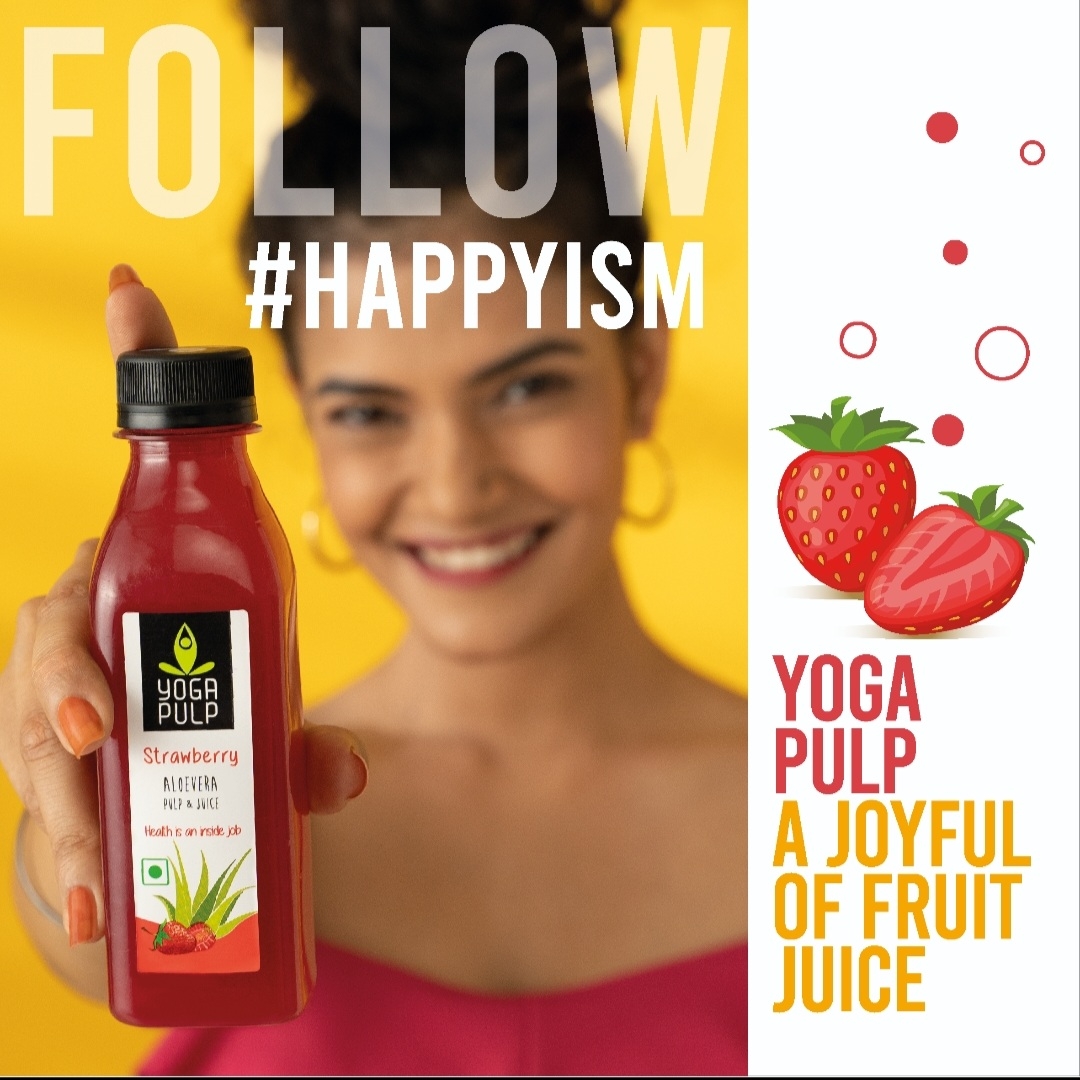
So when happiness became the central idea behind the YogaPulp advertising campaign, the challenge wasn't simply to make people look happy. It was to make that happiness believable.
For me, that meant creating an atmosphere in which the people in front of the camera could actually reach that emotion — through conversation, humour, music, movement or whatever worked with that particular person. We had a wonderfully diverse cast, from a seven-year-old child to young models and older adults. Naturally, happiness couldn't look the same on every face.
The trick was not to direct the smile. It was to create the moment that produced it.


The unexpected face of happiness
One of my favourite casting decisions in the campaign wasn't really a casting decision at all.
A few months earlier, while filming a project for Mumbai Police about their outreach to senior citizens living alone, I had met a wonderfully warm woman named Sonal Bathija, around 70 years old. We had filmed at her home, and during the shoot she began dancing and laughing. She told me that she had always wanted to appear in an advertisement and asked me to remember her if I ever had something suitable.
I did.
In the middle of the YogaPulp shoot, Sandeep from Palasa Creatives came up to me with a problem. We had children, youngsters and adults in our group shots, but somehow it still wasn't feeling like a family.
I agreed. A celebration, after all, doesn't belong to one age group.
The problem was that we were already shooting. There was no time to begin another casting exercise.
And suddenly I remembered Sonal.
Sandeep asked, “Is she a professional?”
I had to choose my words rather carefully.
She wasn't a professional model, but I remembered her warmth, spontaneity and complete lack of inhibition in front of the camera. I had a feeling she could pull it off.
I called her. She was delighted.
Ten minutes later, Sonal Bathija was at the studio.
And she brought exactly what we had been missing.
Her laughter was genuine. She enjoyed herself enormously, everyone enjoyed having her around, and suddenly the group had another generation in it. What had looked like a collection of models began to feel much closer to a family.
Sometimes casting isn't about finding the perfect face in a catalogue. Sometimes it is simply about remembering the right human being at the right moment.

The client was very clear about what he wanted in the films: fresh fruit, juice and dramatic splashes captured in extreme slow motion.
We didn't want to fall back on generic stock footage. If those images were going to be part of the YogaPulp campaign, we wanted to create them ourselves.
That immediately changed the technical requirements of the shoot.
The traditional choice for this kind of extreme high-speed cinematography would have been a specialised camera such as a Phantom, but that would have added substantially to the production cost. Around that time, we discovered the Freefly Wave, a remarkably compact high-speed camera that had recently entered the market.
Veteran cinematographer Sunil Patel and I discussed its possibilities and decided to use the Wave for our extreme slow-motion product sequences. At 2K resolution, the camera could go beyond 1,400 frames per second, comfortably giving us the approximately 1,000 fps territory we wanted for the splashes.
But solving one problem created several others.
The higher the frame rate, the more light you need.
Additional large LED panels had to be brought in for the high-speed sequences. The fruits had to be styled and positioned precisely, the products carefully placed, and the liquid splashes repeatedly choreographed until everything came together in that fraction of a second.
Macro lenses took us even closer — into the colour, texture, pulp and movement of the fruit and juice.
And then there was the data.
Shooting high-speed RAW generates an enormous amount of it. Storage, downloading and transfer time suddenly become part of the filmmaking process. A couple of seconds of beautiful slow-motion imagery on screen can represent a surprisingly substantial exercise behind the camera.
Ironically, shooting the models was relatively easy.
Making fruit and juice perform for the camera was considerably harder.
One campaign, two ways of seeing
The entire campaign was shot over two days, with Rupali Talan as Creative Director, working closely on maintaining a common sense of freshness and energy across the print campaign and films.
For the advertising films, we had Sunil Patel as cinematographer. His career spans advertising and feature films, with film work including Hum Tum, Salaam Namaste, Bachna Ae Haseeno and Bang Bang, starring Hrithik Roshan and Katrina Kaif.
Behind YogaPulp was Nitin Gupta, with whom I had earlier worked on his other brands, including Restless and Buzz energy drinks. Having worked together before, there was already an understanding of how we approached advertising imagery — and naturally, high expectations from this campaign.
The YogaPulp advertising campaign eventually resulted in three advertising films along with the print campaign. Here is one of the films, where the high-speed cinematography, product imagery and our approach to capturing happiness came together.
Looking back, YogaPulp brought together two very different aspects of image-making.
When photographing or filming people, sometimes you have to stop controlling the expression and create the circumstances in which a genuine emotion can emerge.
With a product, sometimes it is exactly the opposite. Every lens, light, frame, texture, splash and fraction of a second has to be controlled.

Photography & Film director: Pravin Talan
Photography & Creative Director: Rupali Talan
Creative consultant -Abhishek De
Cinematography: Sunil Patel
Production: The Art of Visuals
Agency -Palasa Creatives


Comments